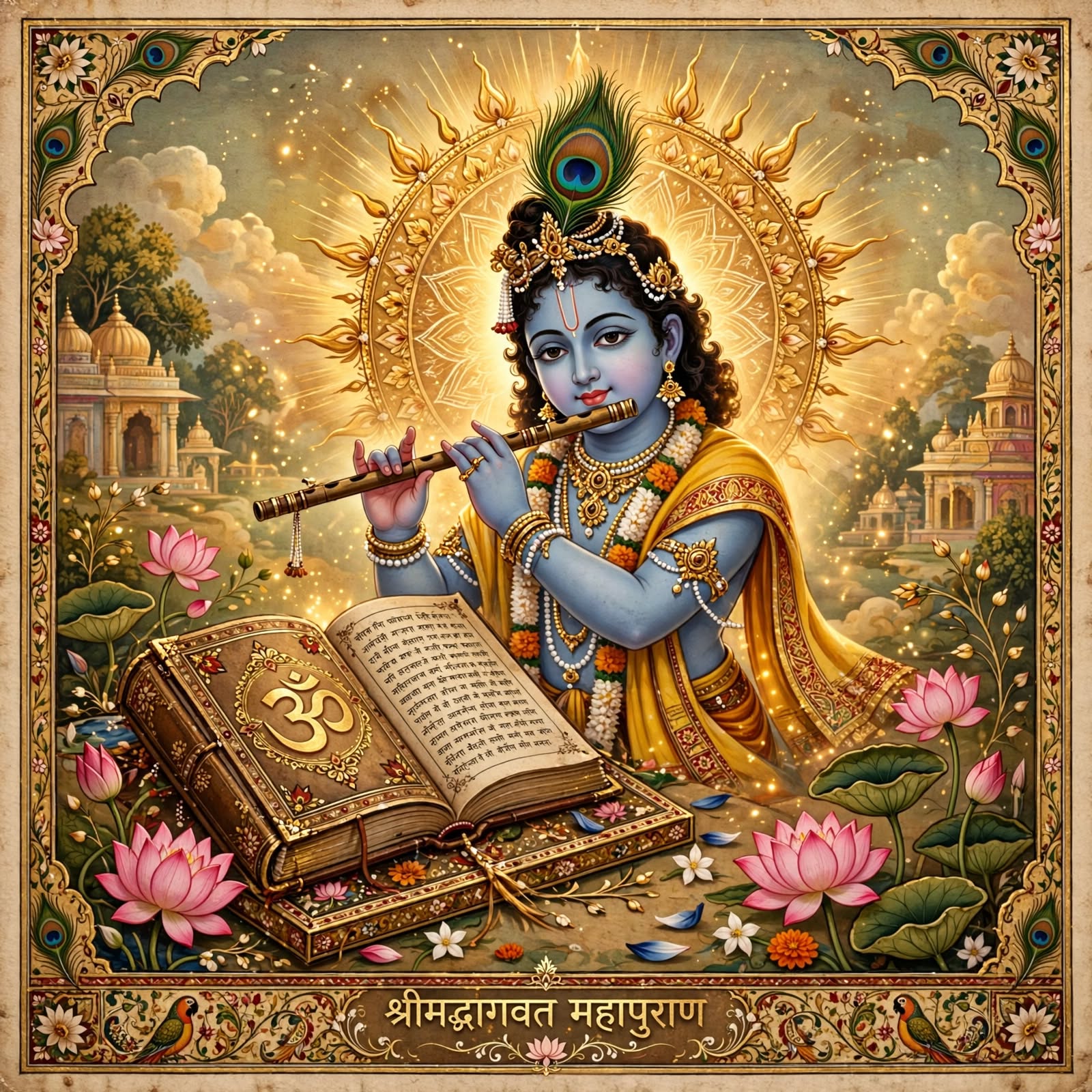
Sanjaya said: O King, seeing the army of the Pandavas arranged in military formation, King Duryodhana approached his teacher Dronacharya and spoke these words:
There are the courageous Yudhamanyu, the mighty Uttamauja, the son of Subhadra (Abhimanyu), and the sons of Draupadi—all indeed great chariot warriors.
758
श्रीमद्भागवत महापुराण
अध्याय 1 • श्लोक क्रमांक 7
अस्माकं तु विशिष्टा ये तान्निबोध द्विजोत्तम ।
नायका मम सैन्यस्य संज्ञार्थं तान्ब्रवीमि ते ॥१-७॥
asmākaṁ tu viśiṣṭā ye tānnibodha dvijottama |
nāyakā mama sainyasya saṁjñārthaṁ tānbravīmi te || 1-7 ||
सरल भावार्थ (English):
O best of the twice-born, know also the distinguished heroes on our side, the generals of my army. For your information, I recount their names to you.
801
श्रीमद्भागवत महापुराण
अध्याय 1 • श्लोक क्रमांक 8
भवान्भीष्मश्च कर्णश्च कृपश्च समितिञ्जयः ।
अश्वत्थामा विकर्णश्च सौमदत्तिस्तथैव च ॥१-८॥
There are your honorable self, Bhishma, Karna, and Kripa, who are ever victorious in battle; and also Ashwatthama, Vikarna, and the son of Somadatta (Bhurishrava).
844
श्रीमद्भागवत महापुराण
अध्याय 1 • श्लोक क्रमांक 9
अन्ये च बहवः शूरा मदर्थे त्यक्तजीविताः ।
नाना loopशस्त्रप्रहरणाः सर्वे युद्धविशारदाः ॥१-९॥
There are many other heroes who are prepared to lay down their lives for my sake. All of them are well equipped with diverse weapons, and all are experienced in military science.
Our strength is immeasurable, and we are perfectly protected by Grandfather Bhishma, whereas the strength of the Pandavas, carefully protected by Bhima, is limited.
930
श्रीमद्भागवत महापुराण
अध्याय 1 • श्लोक क्रमांक 11
अयनेषु च सर्वेषु यथाभागमवस्थिताः ।
भीष्ममेवाभिरक्षन्तु भवन्तः सर्व एव हि ॥१-११॥
ayaneṣu ca sarveṣu yathābhāgamavasthitāḥ |
bhīṣmamevābhirakṣantu bhavantaḥ sarva eva hi || 1-11 ||
सरल भावार्थ (English):
Therefore, stationed firmly in your respective strategic positions at the entrance to all divisions of the army, all of you must give full protection to Grandfather Bhishma alone.
973
ॐ
अनुवृत्ति एवं दार्शनिक सारश्लोक 11 के पश्चात चिंतन
War is nothing new in this world. Thousands of years ago, battles like Kurukshetra were fought to resolve disagreements between right and wrong, and for material wealth. From ancient times to modern days, not a single day has passed without war occurring somewhere on Earth. History shows that while people occasionally gathered for wealth, glory, or to demonstrate greatness, more often they did so out of pettiness. This cycle repeats itself even in the twenty-first century, making war seem like an inevitable destiny of human civilization driven by karma.
On the other hand, peace is difficult to attain. Peace is widely discussed and prayed for, yet rarely experienced for more than a fleeting moment. Most of a person’s life—no matter how simple—is spent struggling to sustain social, political, economic, mental, or physical existence. For most, peace is merely the temporary absence of major distress. However, genuine peace is a state of consciousness, not an external condition of the material world; it is an internal realization.
The wisdom of Vedic literature reveals in Srimad Bhagavatam: jivo jivasya jivanam—one living entity is the food of another. From microscopic microbes to complex organisms, one being subsists on the destruction of another. Hence, the very foundation of material existence is flawed by inherent violence. For most of us, peace comes from performing our prescribed duties with the conviction that what we did was right. Here lies the subtle difference between war and peace: is what we accept as right truly right, or merely what we are conditioned to believe?
Our capacity to discern right from wrong, virtue from sin, depends on the breadth of the knowledge from which we draw our conclusions. Incomplete knowledge inevitably leads to faulty outcomes. Therefore, discovering the highest source of knowledge, uncovering the Absolute Truth, and cultivating that wisdom is in our ultimate best interest.
Throughout the world, the Bhagavad Gita is arguably the most widely read treatise on theism. Whatever wisdom is found in other holy scriptures, such as the Dhammapada, the Bible, the Torah, or the Quran, is contained in the Gita. Yet the Gita also reveals wisdom that cannot be found anywhere else. Thus, it stands supreme among branches of spiritual knowledge. These commentaries offer a glimpse into the vastness of the Absolute Truth contained within the Bhagavad Gita.
Then, the glorious patriarch of the Kuru dynasty, Grandfather Bhishma, roared loudly like a lion and blew his conch shell to raise Duryodhana's spirits.
1059
श्रीमद्भागवत महापुराण
अध्याय 1 • श्लोक क्रमांक 13
ततः शङ्खाश्च भेर्यश्च पणवानकगोमुखाः ।
सहसैवाभ्यहन्यन्त स शब्दस्तुमुलोऽभवत् ॥१-१३॥
Immediately after that, conch shells, kettledrums, tabors, trumpets, and cow-horns blared out simultaneously, creating a tumultuous and deafening roar.
On the other side of the battlefield, seated upon a grand chariot yoked with white horses, Madhava (Lord Krishna) and Arjuna blew their divine conch shells.
Hrishikesha (Lord Krishna) blew His conch shell named Panchajanya; Dhananjaya (Arjuna) blew the Devadatta; and Bhima, the performer of terrible deeds, blew his mighty conch named Paundra.
1188
श्रीमद्भागवत महापुराण
अध्याय 1 • श्लोक क्रमांक 16
अनन्तविजयं राजा कुन्तीपुत्रो युधिष्ठिरः ।
नकुलः सहदेवश्च सुघोषमणिपुष्पकौ ॥१-१६॥
That tumultuous sound, reverberating through heaven and earth, shattered the hearts of Dhritarashtra’s sons.
1360
ॐ
अनुवृत्ति एवं दार्शनिक सारश्लोक 19 के पश्चात चिंतन
At the very outset of the Kurukshetra war, Duryodhana made a critical strategic error by underestimating the strength of his adversaries. Blinded by greed for the kingdom and deep-rooted hostility toward his cousins, the Pandavas, he entered battle convinced their power was severely limited.
Hostility and greed are perilous companions to intellect, routinely producing flawed judgments and senseless loss of life. Modern history presents parallel examples in the wars of Vietnam, Iraq, and Afghanistan, where public sentiment was overridden, leading to catastrophic human casualties.
Traditional commentators on the Bhagavad Gita highlight Duryodhana's grave oversight: failing to recognize that with the Supreme Lord Sri Krishna acting as Arjuna's charioteer and guide, Arjuna stood as an invincible opponent.
History demonstrates that wars are typically driven by greed, animosity, or ideological conflict. Yet combatants frequently invoke the reassuring notion that "God is on our side"—a sentiment that has bolstered armies across epochs. Often termed the "theology of convenience," both factions routinely claim divine mandate for their violence.
Kurukshetra differed fundamentally from modern ideological warfare. It was a fratricidal conflict arising from human flaws: lust for power, breach of duty, jealousy, emotional attachments, and bodily identification. Unlike other wars, however, Kurukshetra yielded an enduring spiritual legacy. Through the dialogue of the Bhagavad Gita, Sri Krishna provided timeless guidance that enables humanity to overcome mundane frailties and attain self-realization.
At that time, O King, as the weapons were about to be unleashed, the son of Pandu, Arjuna, seated upon his chariot bearing the flag of Hanuman, lifted his bow and spoke these words to Lord Hrishikesha.
Arjuna said: O Infallible Lord, please station my chariot between the two armies so that I may behold those assembled here desiring battle, and know with whom I must contend in this strife of war.
Sanjaya said: O descendant of Bharata, having been thus addressed by Gudakesha (Arjuna), Lord Hrishikesha placed that finest of chariots in the midst of both armies.
1575
श्रीमद्भागवत महापुराण
अध्याय 1 • श्लोक क्रमांक 25
भीष्मद्रोणप्रमुखतः सर्वेषां च महीक्षिताम् ।
उवाच पार्थ पश्यैतान्समवेतान्कुरूनिति ॥१-२५॥
There Arjuna saw stationed in both armies grandfathers, fathers, teachers, maternal uncles, brothers, sons, grandsons, companions, fathers-in-law, and well-wishers.
1661
श्रीमद्भागवत महापुराण
अध्याय 1 • श्लोक क्रमांक 27
तान्समीक्ष्य स कौन्तेयः सर्वान्बन्धूनवस्थितान् ।
कृपया परयाविष्टो विषीदन्निदमब्रवीत् ॥१-२७॥
Seeing all those relatives arrayed there, the son of Kunti, Arjuna, was overwhelmed with immense compassion and lamented thus.
1704
श्रीमद्भागवत महापुराण
अध्याय 1 • श्लोक क्रमांक 28
अर्जुन उवाच ।
दृष्ट्वेमं स्वजनं कृष्ण युयुत्सुं समुपस्थितम् ।
सीदन्ति मम गात्राणि मुखं च परिशुष्यति ॥१-२८॥
arjuna uvāca |
dṛṣṭvemaṁ svajanaṁ kṛṣṇa yuyutsuṁ samupasthitam |
sīdanti mama gātrāṇi mukhaṁ ca pariśuṣyati || 1-28 ||
सरल भावार्थ (English):
Arjuna said: O Krishna, seeing my own kinsmen gathered here eager for battle, my limbs fail me and my mouth is utterly parched.
1747
ॐ
अनुवृत्ति एवं दार्शनिक सारश्लोक 28 के पश्चात चिंतन
Lord Krishna took the reins of Arjuna's chariot and is therefore glorified as Parthasarathi. Because Krishna was Arjuna's intimate friend and confidant, Arjuna requested Him to place the chariot between the two opposing forces so that he could evaluate his adversaries. Yet, upon beholding his own revered elders, teachers, and kinsmen standing ready for slaughter, Arjuna was seized by deep bewilderment and grief.
The cosmic stage of Kurukshetra was now set for Lord Krishna to deliver the transcendent wisdom of the Bhagavad Gita. Overwhelmed by lamentation, Arjuna faltered from his prescribed duty. As an honorable Kshatriya, he was duty-bound to uphold righteousness through battle, yet the emotional agony of confronting his loved ones made him recoil.
The material realm is rife with injustice and conflict. As the philosopher Edmund Burke once observed, "The only thing necessary for the triumph of evil is for good men to do nothing."
Arjuna contemplated abandoning the fight, rationalizing that the destruction of his dynasty would lead to moral collapse. Yet deep within, he recognized that passive resignation in the face of unrighteousness would yield consequences far more catastrophic.
My whole body trembles, my hair stands on end, the bow Gandiva slips from my hand, and my skin burns intensely.
1833
श्रीमद्भागवत महापुराण
अध्याय 1 • श्लोक क्रमांक 30
न च शक्नोम्यवस्थातुं भ्रमतीव च मे मनः ।
निमित्तानि च पश्यामि विपरीतानि केशव ॥१-३०॥
na ca śaknomyavasthātuṁ bhramatīva ca me manaḥ |
nimittāni ca paśyāmi viparītāni keśava || 1-30 ||
सरल भावार्थ (English):
I am unable to remain standing, my mind reels in bewilderment, and I foresee only adverse omens, O Kesava.
1876
श्रीमद्भागवत महापुराण
अध्याय 1 • श्लोक क्रमांक 31
न च श्रेयोऽनुपश्यामि हत्वा स्वजनमाहवे ।
न काङ्क्षे विजयं कृष्ण न च राज्यं सुखानि च ॥१-३१॥
na ca śreyo'nupaśyāmi hatvā svajanamāhave |
na kāṅkṣe vijayaṁ kṛṣṇa na ca rājyaṁ sukhāni ca || 1-31 ||
सरल भावार्थ (English):
I see no good emerging from slaying my own relatives in battle, nor do I covet victory, O Krishna, nor sovereign rule, nor sensual joys.
1919
श्रीमद्भागवत महापुराण
अध्याय 1 • श्लोक क्रमांक 32
किं नो राज्येन गोविन्द किं भोगैर्जीवितेन वा ।
येषामर्थे काङ्क्षितं नो राज्यं भोगाः सुखानि च ॥१-३२॥
kiṁ no rājyena govinda kiṁ bhogairjīvitena vā |
yeṣāmarthe kāṅkṣitaṁ no rājyaṁ bhogāḥ sukhāni ca || 1-32 ||
सरल भावार्थ (English):
O Govinda, of what avail to us is kingdom, or pleasures, or even life itself, when those for whose sake we desire them stand assembled before us?
1962
श्रीमद्भागवत महापुराण
अध्याय 1 • श्लोक क्रमांक 33
त इमेऽवस्थिता युद्धे प्राणांस्त्यक्त्वा धनानि च ।
आचार्याः पितरः पुत्रास्तथैव च पितामहाः ॥१-३३॥
ta ime'vasthitā yuddhe prāṇāṁstyaktvā dhanāni ca |
ācāryāḥ pitaraḥ putrāstathaiva ca pitāmahāḥ || 1-33 ||
सरल भावार्थ (English):
Teachers, fathers, sons, grandfathers, maternal uncles, fathers-in-law, grandsons, brothers-in-law, and other kinsmen stand here, renouncing both their wealth and lives.
api trailokyarājyasya hetoḥ kiṁ nu mahīkṛte |
nihatya dhārtarāṣṭrānnaḥ kā prītiḥ syājjanārdana || 1-35 ||
सरल भावार्थ (English):
Even for dominion over the three worlds, let alone for this fleeting earthly realm, I would not strike them, O Janardana. What joy could we possibly derive from killing the sons of Dhritarashtra?
2091
श्रीमद्भागवत महापुराण
अध्याय 1 • श्लोक क्रमांक 36
पापमेवाश्रयेदस्मान्हत्वैतानाततायिनः ।
तस्मान्नार्हा वयं हन्तुं धार्तराष्ट्रान्स्वबान्धवान् ।
स्वजनं हि कथं हत्वा सुखिनः स्याम माधव ॥१-३६॥
Sin alone will alight upon us if we slay these aggressors. Therefore, we ought not to kill our own kinsmen, the sons of Dhritarashtra. How can we ever be happy by slaying our own people, O Madhava?
2134
श्रीमद्भागवत महापुराण
अध्याय 1 • श्लोक क्रमांक 37
यद्यप्येते न पश्यन्ति लोभोपहतचेतसः ।
कुलक्षयकृतं दोषं मित्रद्रोहे च पातकम् ॥१-३७॥
yadyapyete na paśyanti lobhopahatacetasaḥ |
kulakṣayakṛtaṁ doṣaṁ mitradrohe ca pātakam || 1-37 ||
सरल भावार्थ (English):
Even if their intelligence, overwhelmed by greed, perceives no evil in the annihilation of families and no sin in treachery toward companions —
2177
श्रीमद्भागवत महापुराण
अध्याय 1 • श्लोक क्रमांक 38
कथं न ज्ञेयमस्माभिः पापादस्मान्निवर्तितुम् ।
कुलक्षयकृतं दोषं प्रपश्यद्भिर्जनार्दन ॥१-३८॥
Why should not we, who plainly behold the grievous sin arising from the devastation of lineage, resolve to turn back from such wrongdoing, O Janardana?
From the prevalence of unrighteousness, O Krishna, the women of the family become corrupt; and when the women are defiled, O scion of Vrishni, an unholy mixture of classes arises.
This intermingling drags the family and its destroyers down to hell; deprived of the funeral oblations of rice and water, their forefathers fall from grace.
By these catastrophic misdeeds of the ruinous kinsmen, which introduce sociological confusion, the timeless community codes and family devotions are utterly erased.
O Janardana, we have learned through ancient sacred testimony that those humans whose family duties are dismantled are condemned to dwell in hell perpetually.
Alas, what immense misfortune that we have resolved to perpetrate a heinous evil, preparing to slaughter our own brethren out of lust for power and royal comfort!
2478
श्रीमद्भागवत महापुराण
अध्याय 1 • श्लोक क्रमांक 45
यदि मामप्रतीकारमशस्त्रं शस्त्रपाणयः ।
धार्तराष्ट्रा रणे हन्युस्तन्मे क्षेमतरं भवेत् ॥१-४५॥
Far better would it be for me if the armed sons of Dhritarashtra should cut me down on the battlefield while I remain unarmed and completely unresisting.
Sanjaya said: Having spoken these words amid the battle ranks, Arjuna cast down his bow and quiver, and plunged in profound desolation, sank back upon the bench of his chariot.
2564
ॐ
अनुवृत्ति एवं दार्शनिक सारश्लोक 46 के पश्चात चिंतन
Metaphorically, Arjuna stood caught between profound spiritual and moral impasses. Exercising wisdom, he turned to Sri Krishna for transcendent counsel. Acknowledging Krishna as the Absolute Truth and repository of all opulences, Arjuna addressed Him by His sacred divine epithets: Hrishikesha (Lord of the senses), Achyuta (the Infallible), Keshava (Slayer of the Keshi demon), Govinda (Giver of pleasure to cows and senses), Madhusudana (Slayer of Madhu), Janardana (Maintainer of all beings), Madhava (Consort of the Goddess of Fortune), and Varshneya (Scion of the Vrishnis).
Arjuna invoked these names to implore divine compassion in his moral paralysis. As Hrishikesha, Krishna is immune to material bewilderment; as Achyuta, His judgment never errs. Arjuna desperately needed guidance anchored in infallible authority to calm his distraught mind.
Krishna as Keshava represents the vanquisher of the pride and deception embodied by the Keshi demon. His demon-slaying pastimes symbolize the uprooting of lust, wrath, greed, and delusion that choke spiritual elevation. Convinced that taking shelter of Krishna would dissolve his moral crisis, Arjuna addressed Him as Varshneya to highlight family honor, the preservation of which remained his deepest apprehension.
Om Tat Sat. Thus, in the Upanishad of the holy Bhagavad Gita, the science of the Supreme Spirit, the scripture of Yoga, and the sacred dialogue between Sri Krishna and Arjuna, concludes the first chapter entitled "Sainya-Darshanam" (Observing the Armies on the Battlefield).
2650
Daily Gita Sadhana
Listen to One Sacred Verse Daily & Practice in Life
Original Sanskrit verses of Shrimad Bhagavad Gita with accurate commentary in English & Indian regional languages.